Zinc Is Now a Critical Mineral — And Why Galvanizing Matters More Than Ever
Across the world, governments are rethinking how they build, protect, and sustain infrastructure. One of the most significant shifts — though still not widely understood outside technical circles, is the growing recognition of zinc as a critical mineral.
Zinc Is Now a Critical Mineral — And Why Galvanizing Matters More Than Ever
Across the world, governments are rethinking how they build, protect, and sustain infrastructure. One of the most significant shifts — though still not widely understood outside technical circles, is the growing recognition of zinc as a critical mineral.
Canada, the United States, the European Union, and other global regions now classify zinc as strategically essential for clean energy, resilient infrastructure, and long-term national competitiveness. As the demand for durable, low-carbon assets increases, galvanizing emerges as one of the most impactful ways zinc delivers value to society.
Below, we explore what this means for Canada’s infrastructure and why the galvanizing sector stands at the centre of this transformation.
1. Why Zinc Made the “Critical Mineral” List
Zinc is indispensable in three fast-growing sectors:
Infrastructure durability (hot-dip galvanizing uses more zinc than any other application)
Clean energy technologies (renewables, batteries, and transmission systems)
Low-carbon industrial strategies requiring longer service life and reduced maintenance emissions
Governments classify a mineral as critical when
It is essential to economic or national security
Supply chains are vulnerable
Demand is rapidly rising across strategic industries
Zinc meets all three. The world cannot transition to cleaner, more resilient infrastructure without it.
2. The Link Between Zinc and Sustainable Infrastructure
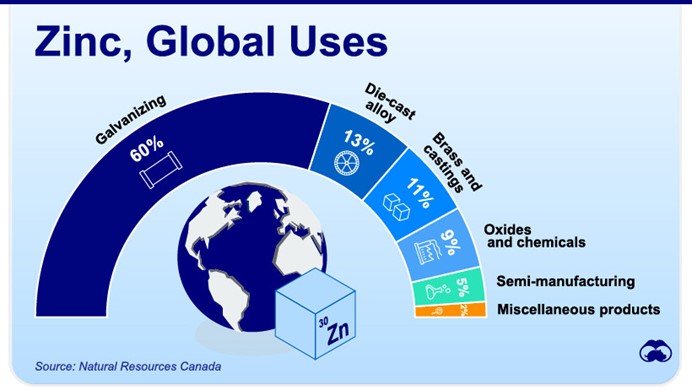
Most people associate zinc with batteries or specialized alloys — but far more zinc is used for corrosion protection of steel.
Hot-dip galvanizing:
Extends service life of steel by 70–100+ years
Eliminates repeated maintenance cycles
Reduces lifecycle emissions dramatically
Supports local fabrication and domestic supply chains
Protects Canada’s infrastructure from harsh climates and de-icing salts
As infrastructure owners shift from first cost thinking to whole-life carbon, galvanizing becomes a cornerstone technology.
Zinc is not simply a coating — it is a strategic asset for national durability.
3. Why This Matters for Canada’s Policy Landscape
Canada is now moving toward:
Buy Clean–style procurement
Supply-chain protection for Canadian steel and manufacturing
Lifecycle-based design, including PAS 2080 principles
Longer design service life for bridges and public infrastructure
Zinc’s new status strengthens the case for:
Specifying galvanizing early in design
Ensuring access to domestic zinc supply
Supporting Canadian galvanizers and fabricators as part of a national resilience strategy
Every bridge, sign structure, guardrail, transit asset, or public building protected by galvanizing relies directly on this critical mineral.
4. Global Demand Is Rising Faster Than Supply
International forecasts show:
Zinc demand for infrastructure will double by 2050
Zinc demand for clean energy technologies will triple
The world will require more zinc than currently produced unless recycling rates increase and mining expands sustainably
For Canada, where galvanizing already plays a central role in infrastructure, this reinforces the need for:
Stable local supply
Long-term planning
Modernized standards that recognize zinc’s durability advantage
Canada’s galvanizing industry sits at the intersection of critical minerals, clean tech, and infrastructure transformation.
5. What This Means for Engineers, Designers & Policymakers
Zinc’s critical mineral designation is not an abstract policy shift — it has practical implications:
For engineers & designers
Galvanizing should be considered a default corrosion protection strategy for long-life structures
LCA tools now recognize the carbon advantage of durable coatings
Duplex systems offer even longer performance for complex or coastal environments
Policies that protect Canadian fabrication and galvanizing are also protecting critical mineral value chains
For owners & municipalities
Every galvanized structure is a long-term investment with dramatically lower maintenance budgets
Zinc helps municipalities meet climate pledges through reduced lifecycle emissions
6. The Bottom Line: Galvanizing Is Becoming Even More Strategic
As the world races to build cleaner, more resilient infrastructure, zinc is no longer just a commodity — it is a pillar of national strategy.
And because galvanizing is the single largest use of zinc globally, the galvanizing community plays a key role in:
Extending infrastructure life
Reducing carbon emissions
Strengthening domestic supply chains
Supporting economic resilience
For Canada, this is an opportunity to lead:
a modern infrastructure strategy must include modern galvanizing strategy.
Published On:
December 4, 2025
Join Us in Strengthening Canada’s Infrastructure
Ready to advance galvanizing excellence, influence national standards, and support sustainable, resilient construction across Canada? Connect with us today and become part of the movement.